.NET Core and Angular have become a powerful combination for building high-performance, scalable web portals. In this article, we will explore why modern businesses increasingly choose .NET Core for back-end services and Angular for front-end experiences, which architectural patterns work best, and what to consider when assembling or scaling a development team for complex portal solutions.
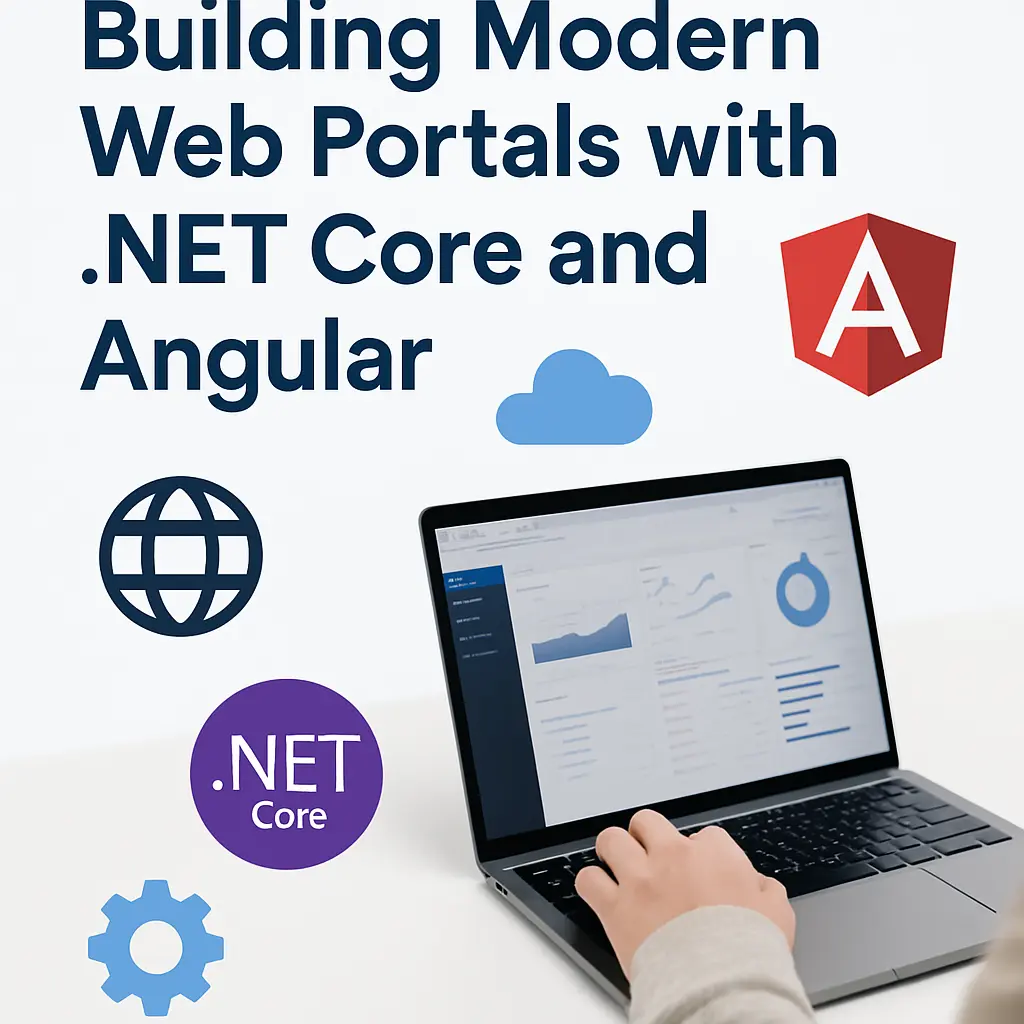
Building Modern Web Portals with .NET Core and Angular
Modern web portals have evolved far beyond static websites or simple dashboards. Enterprises now expect integrated digital hubs where customers, partners, and employees can access data, workflows, and personalized experiences in real time. This shift has driven the need for robust architectures and technologies that can handle complexity while remaining flexible and maintainable.
On the server side, .NET Core (now part of .NET 8+) offers cross-platform capabilities, high performance, and first-class tooling support. It is ideal for API-driven architectures, microservices, and cloud-native deployments. Angular complements this at the front end with a powerful component-based framework that excels at building rich, interactive single-page applications (SPAs) and complex UI workflows.
Many organizations therefore gravitate toward custom .net portal development that leverages this tandem. The result is a technology stack that can support diverse business requirements, from internal enterprise portals to large-scale customer self-service platforms, while remaining future-proof and extensible.
Key Capabilities of .NET Core for Portals
.NET Core brings several technical features that are especially beneficial for portal projects:
- High performance and scalability: ASP.NET Core is known for its speed and low memory footprint. It can efficiently handle concurrent users, long-running background processes, and real-time communication via SignalR.
- Cross-platform and container-friendly: Applications can run on Windows, Linux, or macOS and are easy to containerize with Docker, enabling consistent environments and simplified DevOps pipelines.
- Modular middleware pipeline: ASP.NET Core’s middleware pipeline allows fine-grained control over request handling (security, logging, routing, caching), which is crucial for complex multi-tenant or role-based portals.
- Robust security stack: Built-in features like authentication middleware, authorization policies, data protection APIs, and integration with identity providers (Azure AD, IdentityServer, OAuth/OIDC) support strict security requirements.
- API-first design: Web APIs in .NET Core (using minimal APIs or controllers) are straightforward to build and integrate with any SPA or mobile clients, making them ideal for Angular-driven front ends.
- Rich ecosystem and tooling: Visual Studio, Rider, and VS Code provide advanced debugging, profiling, and refactoring tools. Mature libraries for logging, caching, ORM (Entity Framework Core), and messaging are readily available.
Angular as the Front-End Powerhouse
While .NET Core handles the back end, Angular is designed to manage the complexity of dynamic user interfaces:
- Component-based architecture: Reusable, encapsulated components reduce duplication and allow teams to maintain consistent UI patterns across large portals.
- TypeScript and strong typing: TypeScript brings compile-time checks, better tooling, and clear contracts between layers, which is especially important in large enterprise projects with many contributors.
- Reactive programming with RxJS: Angular’s emphasis on observables and reactivity enables sophisticated real-time features, data streams, and responsive UI behaviors.
- Routing and state management: Angular Router supports nested routes, lazy loading, and guards; combined with state management solutions (NgRx, Akita, NGXS), it helps keep complex interactions predictable and testable.
- Form handling and validation: Angular offers powerful reactive forms and validation capabilities, perfect for portals with extensive data entry, workflows, and conditional logic.
- Enterprise-ready tooling: Angular CLI standardizes project structure, testing, and builds, making it easier to enforce best practices and maintain code quality over time.
Why .NET Core + Angular Is a Strategic Stack
Combining .NET Core and Angular creates a cohesive full-stack environment aligned around several strategic benefits:
- Separation of concerns: The back end focuses on business logic, data access, and security, while the front end handles user experience and presentation. This separation enables independent scaling, deployment, and evolution of each tier.
- Improved developer productivity: Strong typing on both ends (C# and TypeScript) reduces runtime errors and clarifies interface contracts. Shared models and clear APIs help teams iterate faster with fewer regressions.
- Cloud-native readiness: .NET Core APIs and Angular apps deploy naturally to cloud platforms (Azure, AWS, GCP) using containers, serverless functions, or PaaS offerings. This fits well with auto-scaling, load balancing, and global distribution.
- Long-term support and stability: Both technologies are backed by large communities and strong vendor support, with regular LTS releases. This is critical for portals expected to live and evolve for many years.
Typical Use Cases for .NET Core–Angular Portals
This stack is particularly suitable for:
- Customer self-service portals: Bill payment, subscription management, order tracking, and profile management with real-time notifications.
- Partner and vendor portals: Onboarding workflows, contract management, inventory visibility, and integrated document handling.
- Employee and intranet portals: HR self-service, time tracking, internal knowledge bases, dashboards, and workflow automation.
- Industry-specific platforms: Healthcare patient portals, financial account dashboards, educational LMS interfaces, or logistics tracking systems.
Each of these scenarios requires robust security, configurable workflows, role-based access, and the ability to integrate with multiple external systems, all of which are strong points for a .NET Core back end and Angular front end.
Core Architectural Decisions
Before writing code, several architectural choices should be made that will shape the portal’s long-term success:
- Monolith vs. microservices: Smaller or mid-sized portals may start as a well-structured modular monolith in .NET Core, while large, highly scalable systems might favor microservices or a hybrid approach.
- API design style: REST remains the most common for portals, but GraphQL or gRPC are sometimes chosen when complex querying or high-performance internal communication is needed.
- Hosting model: Decisions between on-premises, private cloud, or public cloud impact performance, security controls, and compliance requirements.
- Authentication and authorization model: Centralized identity, SSO, and multi-tenant logic must be architected upfront to avoid major refactoring later.
These decisions directly influence how teams should be composed and which skills are essential, which leads naturally to the question of hiring and structuring development talent.
Hiring and Organizing .NET Core + Angular Teams
Having the right technology stack is only part of a successful portal project; you also need a team that understands how to exploit its strengths and avoid common pitfalls. The demand to hire .net core + angular developers has grown steeply as organizations recognize the advantages of end-to-end expertise in this stack.
Roles and Skill Sets for a Successful Portal Team
For large or strategic portals, you will typically need a combination of the following roles:
- Solution architect: Defines the overall system architecture, integration patterns, security model, and technology choices across .NET Core, Angular, and infrastructure.
- .NET Core back-end developers: Focus on building APIs, business logic, domain models, data access, caching, and integration with third-party systems.
- Angular front-end developers: Specialize in UI/UX implementation, component architecture, state management, routing, and performance optimization in the browser.
- Full-stack developers: Bridge the back-end and front-end layers, help maintain consistency in contracts and data models, and often accelerate delivery in smaller teams.
- DevOps engineers: Build CI/CD pipelines, manage cloud infrastructure, configure monitoring, logging, and observability, and ensure reliable deployments.
- QA and test automation engineers: Implement automated testing across API, UI, and integration layers to safeguard quality during frequent releases.
In smaller setups, several of these roles may be combined; in larger organizations, each may be its own team with specialized responsibilities.
Key Technical Competencies to Look For
When evaluating .NET Core and Angular developers, look beyond basic framework familiarity and emphasize deeper engineering skills:
- Back-end competencies:
- Strong understanding of ASP.NET Core, API design, and middleware.
- Experience with Entity Framework Core or alternative ORMs, and data modeling for relational or NoSQL databases.
- Knowledge of DDD concepts, CQRS, or event-driven patterns where needed.
- Security best practices (JWT, OAuth2/OIDC, input validation, secure storage).
- Front-end competencies:
- Mastery of Angular components, modules, services, and dependency injection.
- Solid understanding of TypeScript, RxJS, and reactive programming patterns.
- Experience with state management solutions (NgRx or alternatives) and advanced routing.
- Accessibility, responsive design, and performance optimization skills.
- Cross-cutting skills:
- Testing practices (unit, integration, end-to-end) using tools like xUnit, NUnit, Jasmine, Jest, or Cypress.
- Familiarity with Git workflows, branching strategies, and code review practices.
- Exposure to CI/CD pipelines (GitHub Actions, Azure DevOps, GitLab CI, etc.).
Team Structure and Collaboration Patterns
How you structure your team significantly affects development velocity and maintainability:
- Vertical slices over horizontal layers: Instead of splitting teams strictly into “back end” and “front end,” consider cross-functional squads owning vertical slices of the portal (e.g., billing, reporting, user management). This encourages end-to-end accountability.
- API contracts as living agreements: Encourage early definition of API contracts between .NET Core and Angular layers using OpenAPI/Swagger. Treat them as living agreements updated alongside code.
- Shared design systems: Maintain a shared UI component library in Angular that can be used across teams, promoting consistency and reducing duplicated effort.
- Regular architecture reviews: Hold periodic reviews to assess technical debt, performance, and security. Involve both front-end and back-end engineers to ensure holistic decisions.
Scaling the Portal and the Team
As the portal grows in complexity and adoption, both the technical architecture and team organization will evolve:
- Modularization and micro frontends: For very large portals, consider modular Angular architectures or micro frontends: separate Angular applications that share shell and routing but can be developed and deployed independently.
- Service decomposition: Break a monolithic .NET Core back end into focused services where it makes sense, especially around bounded contexts or performance hotspots.
- Domain-focused squads: Align team boundaries with business domains rather than technologies, ensuring each squad understands the full lifecycle of its features.
- Knowledge sharing and onboarding: Implement internal documentation, architecture decision records (ADRs), and mentoring programs so new hires can ramp up quickly and maintain quality standards.
Best Practices for Delivering High-Quality Portals
Regardless of stack or team size, a few best practices consistently improve outcomes:
- Start with a clear domain model: Invest early in understanding business processes, roles, and data flows. A well-thought-out domain model in .NET Core guides both API design and Angular UI structures.
- Implement layered or clean architectures: Separate domain logic from infrastructure concerns. In .NET Core, use layered, hexagonal, or clean architecture patterns to make code more testable and change-resilient.
- Use shared DTOs and contracts: Define API contracts with OpenAPI and generate TypeScript clients where appropriate, reducing discrepancies between back-end models and Angular types.
- Automate testing and quality checks: Enforce code quality with static analysis, linting, automated tests, and code coverage thresholds in both .NET and Angular projects.
- Monitor performance and user behavior: Implement observability (logs, metrics, traces) and front-end analytics to detect performance bottlenecks, UI issues, and user friction early.
- Plan for evolution, not perfection: Build with change in mind. Feature flags, toggles, and incremental refactoring keep the portal adaptable without massive rewrites.
Governance, Security, and Compliance
Portals often deal with sensitive data and must comply with regulations (GDPR, HIPAA, PCI-DSS, etc.). Appropriate governance practices include:
- Centralized identity and access management: Integrate .NET Core with enterprise identity providers, enforce MFA, and design role-based access control across APIs and Angular components.
- Secure coding standards: Train developers in secure coding, conduct code reviews with security in mind, and run automated vulnerability scans on dependencies.
- Data protection: Ensure encryption at rest and in transit, proper key management, and careful handling of PII in both back-end and front-end layers.
- Auditability: Implement thorough auditing and logging of sensitive operations and access patterns for investigations and compliance reporting.
Conclusion
.NET Core and Angular together form a robust foundation for modern web portals that must balance performance, security, and rich user experiences. By carefully designing the architecture, investing in the right mix of specialized and full-stack talent, and following disciplined engineering practices, organizations can deliver portals that scale with their business. Thoughtful hiring, clear contracts, and continuous improvement turn this stack into a long-term strategic asset.